Your Own Online Store. No Commissions. No Middlemen.
Shopify and WooCommerce stores built for D2C brands, FMCG companies, food brands, and clothing labels — designed to convert, built for the Indian market, and managed without technical dependency.
Why every growing brand needs its own online store
Instagram DMs, Amazon listings, and WhatsApp forwards can start a business. They cannot build one you own.
Own your customer relationship
When someone buys on Amazon, Amazon owns that customer. Your own store collects name, email, purchase history, and phone — repeat sales get cheaper with every order because you market directly.
Sell around the clock without a team
A well-built store takes orders at 3am on a Sunday. Product pages answer questions, checkout handles payment, and order notifications go out automatically. No manual intervention required.
Build a brand — not a listing
On marketplaces, you're a SKU number competing on price. On your own store, you control photography, packaging presentation, storytelling, and price perception. Brand loyalty is only possible here.
Before you list on Amazon or Flipkart, read this
Marketplaces are effective for discovery. They are designed to prevent you from building a business that belongs to you.
Commissions eat your margin
Amazon India charges 3%–40% commission depending on category — plus fulfillment fees, advertising spend, and returns. On your own store, you pay 1–2% to the payment gateway. That's the entire difference.
You don't own the customer
The buyer's name, email, and purchase history belong to Amazon. You cannot retarget them, email them, or build loyalty. Every re-purchase starts at zero — you're rebuilding the relationship from scratch every time.
Algorithm changes delete your sales
Amazon and Flipkart change ranking algorithms regularly. A single update can drop your product visibility 80% overnight — with no warning, no explanation, and no recourse available to you.
Your brand is invisible
Your competitors are listed next to you at a lower price. Your logo isn't on the box. Your story isn't on the page. There is no brand loyalty to build — only price competition.
Use marketplaces as a discovery channel. Use your own store to build a business that belongs to you.
10,000 followers is not a business. An online store is.
Instagram is the best discovery channel for D2C brands in India. It is also the worst infrastructure to run a business on.
A typical Instagram sale looks like this:
Every step leaks customers. A checkout button converts infinitely better.
Use Instagram to drive traffic to your store. Don't use it as your store.
Shopify, WooCommerce, or Custom? Here's how to choose.
The platform you choose today affects cost, flexibility, maintenance overhead, and how easily your team manages the store next year.
Shopify
Managed platform — built to launch fast
Best for
WooCommerce
Open-source — full control over everything
Best for
Custom Next.js
Custom-built — unlimited performance & UX
Best for
Not sure which fits your business? Let's figure it out in the first call.
Which platform is the right starting point for your business?
Choose Shopify if…
- You want to launch in 4–6 weeks
- You're comfortable with a monthly platform subscription
- You're selling D2C to consumers — fashion, food, lifestyle, beauty
- You plan to sell internationally
- You don't have a developer on your team day-to-day
Choose WooCommerce if…
- You need complex pricing — bulk, B2B, dealer-specific, or tiered
- You want complete ownership with no recurring platform fee
- You're targeting the Indian market primarily (native payment integration)
- You want maximum SEO control and content flexibility
- Your team is comfortable with WordPress basics
Choose Custom if…
- You're expecting 10,000+ orders per month
- You need a completely unique checkout experience
- You want to integrate with existing ERP or inventory systems
- You're building a marketplace or multi-vendor platform
- Performance is non-negotiable (PageSpeed 95+ target)
Built for brands that sell products people love
FMCG & Packaged Goods
Take your products direct-to-consumer. Eliminate distributor margins. Tell your brand story your way.
D2C Fashion & Clothing
Collections, size guides, wishlists, and a mobile checkout that doesn't leak customers at the last step.
Food Brands & Snacks
Nutritional storytelling, combo packs, subscription options — and a checkout built for Indian payment preferences.
Beauty & Skincare
Ingredients transparency, shade selectors, skin concern filters — and a product page that earns the add-to-cart click.
Home Decor & Lifestyle
Room context photography, material and dimension details, and collection-based discovery that drives average order value.
Manufacturers Going D2C
You already make the product. Stop relying on retailers — own the customer relationship and the margin.
Dry Fruits & Nutrition
Quality storytelling, weight variants, gift packaging, and bulk pricing — plus a repeat-purchase flow that drives LTV.
Handicrafts & Artisans
Handmade origin stories, artisan spotlights, and a globally-accessible store that takes international cards and ships worldwide.
A complete online store — not just a theme install
Every project includes design, development, payment integration, shipping setup, SEO, performance optimisation, and training. Nothing is an optional add-on bolted on after the fact.
Design
- Custom homepage, product listing & product detail page
- Mobile-first — designed for thumb navigation
- Brand-consistent typography, colours & spacing
- Cart and checkout page design optimised for conversion
Development
- Full Shopify or WooCommerce store build
- Product catalogue setup — up to 30 products
- Variants, bundles, and combo packs configured
- CMS training so your team manages inventory without help
E-commerce Setup
- Payment gateway — Razorpay, PayU, UPI, or Stripe
- Shipping integration — Shiprocket or manual zones
- Abandoned cart recovery emails configured
- Order notification emails and WhatsApp alerts
SEO & Analytics
- Product schema markup for Google Shopping
- Sitemap, robots.txt, and Search Console connected
- Google Analytics 4 with e-commerce tracking
- Title tags and meta descriptions for every product page
Performance
- Core Web Vitals optimised — fast checkout, no lag
- Image compression and lazy loading
- Mobile page speed: 85+ target on Google PageSpeed
- Lightweight code — no bloated page builders
Training & Handover
- Full admin walkthrough — orders, products, inventory
- Video recording of the training session
- Build defects fixed at no cost — no time limit
- Ongoing store health via a care plan (optional, from ₹7,000/month)
12 things to have ready before your store build begins
You don't need everything on day one — but knowing what's needed in advance means the build runs without delays. We provide a structured brief to guide your content collection.
From first call to first sale — 10 steps
Discovery Call
Platform, products, target buyer, order volume expectations, and launch timeline — confirmed before anything starts.
Store Architecture
URL structure, category hierarchy, product page layout, and navigation design — mapped out and agreed before any design work begins.
Design
Homepage, product listing page, product detail page, cart, checkout, and mobile breakpoints — designed and approved before development.
Content Collection
You gather product data, photos, and copy using our structured brief. We advise on gaps so the build doesn't stall.
Development
Full store build on the approved design. Custom theme or theme-based build depending on scope. Tested across devices.
Product Catalogue Setup
Products uploaded, categorised, variants configured, images attached, and SEO fields filled for every listing.
Payment Gateway
Razorpay or PayU integrated and tested. Test transactions completed for every payment method — card, UPI, netbanking, wallets.
Shipping Setup
Shiprocket connected or manual shipping zones configured. Pincode serviceability mapped. Delivery time and cost rules set.
Testing & QA
Full purchase flow tested on mobile and desktop. All email and WhatsApp notifications verified. You review the live staging store before launch.
Launch & Training
Store goes live. Analytics and Search Console connected. Admin walkthrough recorded — orders, inventory, products, and reports.
Not just a developer — a brand and product person
Product Presentation Instinct
A product page built by someone who understands photography, layout, and visual storytelling converts differently from one built by someone who just codes. I know how products need to be presented to drive the add-to-cart click.
Branding Background
I've worked in branding and packaging design for over 15 years. I understand how Indian consumers respond to product photography, colour psychology, and packaging cues — I bring that into every store I build.
E-commerce-Specific Experience
I've built stores on Shopify and WooCommerce from scratch across food, fashion, FMCG, and B2B categories. I know where Indian customers drop off during checkout — and how to fix it before it costs you orders.
One Person. Direct Communication.
No account managers, no handoff chain. You deal directly with the person designing and building your store — from the first call to launch day. Faster decisions, fewer misunderstandings.
Online stores I've built — all live and selling
View all projects
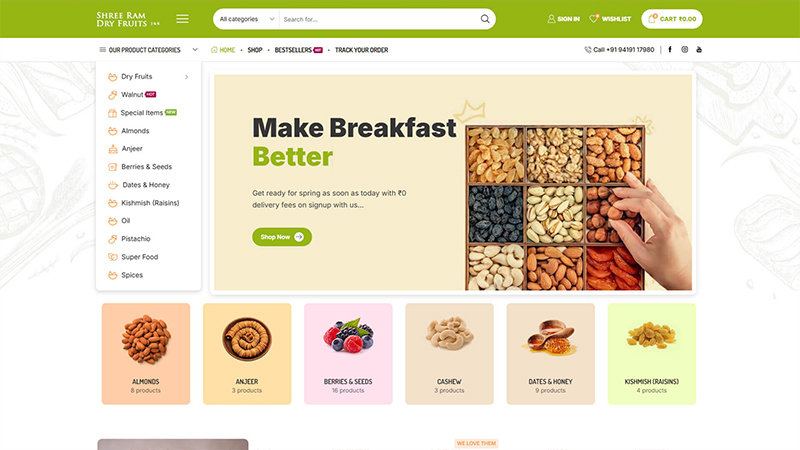
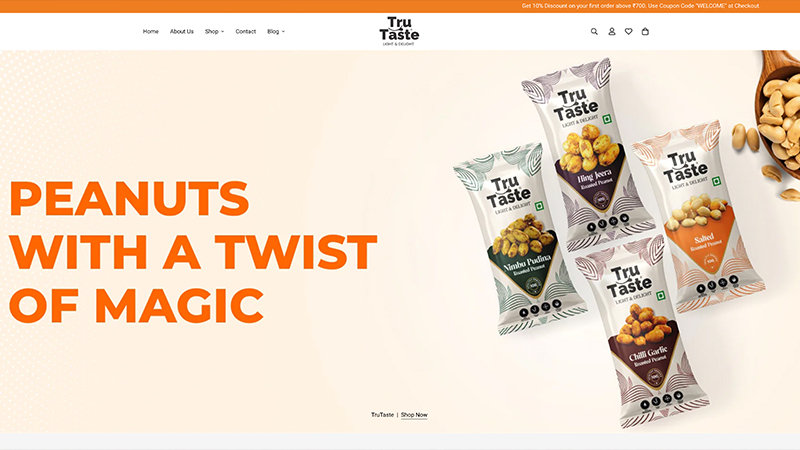
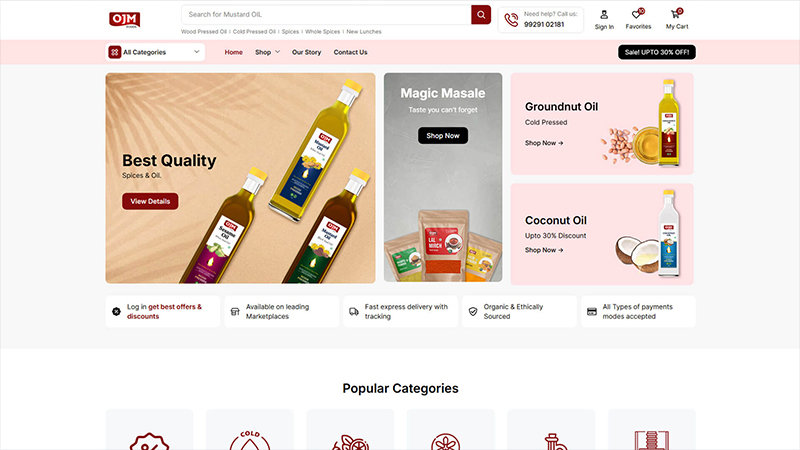
Starting from ₹45,000
Every store is scoped individually. After a 20-minute call, you get a clear itemised quote — no vague estimates, no surprise invoices.
Note: Shopify stores have an ongoing platform subscription ($29–$299/month to Shopify directly). WooCommerce has no platform fee — you pay only for hosting.
What affects the final cost:
- Platform choice — Shopify has a monthly plan fee (from $29/month); WooCommerce is one-time build + hosting
- Number of products — up to 30 included; larger catalogues with 100+ SKUs are scoped separately
- Custom design vs theme-based starting point
- Copywriting for product pages — included if you provide the content brief
- Payment gateway and shipping integrations — standard integrations are included
- Third-party integrations — ERP, CRM, WhatsApp order updates, Google Shopping feed
- Multi-language store — English and Hindi
- B2B pricing features — dealer login, bulk pricing, wholesale catalogue
Common questions about building an online store
Should I use Shopify or WooCommerce?
Shopify is better if you want to launch quickly and prefer paying a monthly platform fee over managing hosting and updates yourself. WooCommerce is better if you need full ownership, complex pricing structures, or deeper integration with Indian payment systems. I'll recommend the right one after a 20-minute discovery call — the decision depends on your products, order volume, and team.
How much does an online store cost?
Stores start from ₹45,000. The final cost depends on your platform choice, number of products, whether custom design is needed, and what integrations are required. After one call, you receive a clear itemised quote — no vague estimates.
How long does it take to launch my store?
A standard Shopify or WooCommerce store with up to 30 products takes 4–6 weeks from content sign-off to launch. The fastest launch I've done is 4 weeks (Trutaste.in — a D2C Shopify store). Larger stores with 100+ products, custom B2B features, or complex shipping rules take 8–10 weeks.
Do I need Shopify's monthly subscription if I choose Shopify?
Yes. Shopify charges a platform fee of $29–$299/month depending on the plan. This covers hosting, platform updates, and their payment infrastructure. It's not a charge from me — it's Shopify's fee. WooCommerce has no platform fee; you pay only for hosting (₹500–₹3,000/month) and the one-time build.
Which payment gateways do you integrate?
Razorpay and PayU for Indian customers — both support cards, UPI, netbanking, and wallets. International stores can include Stripe or PayPal. All payment accounts are registered in your name with your bank settlement details — you own the payment relationship from day one.
How many products can the store handle?
Both Shopify and WooCommerce scale to tens of thousands of products. The initial build includes setup and upload for up to 30 products. Stores with larger catalogues are scoped separately — bulk import tools make adding 200+ products straightforward after the initial build.
Can customers pay using UPI and wallets like Paytm?
Yes. Razorpay and PayU — the two payment gateways I recommend — support all major Indian payment methods: UPI (Google Pay, PhonePe, Paytm), cards (Visa, Mastercard, Rupay), netbanking across 50+ banks, and EMI options. Setup is included in every store build.
How do I manage inventory and process orders after launch?
You'll receive a recorded admin training walkthrough after launch covering: adding and editing products, processing orders, managing inventory levels, and viewing sales reports. Shopify has a polished dashboard your team will find intuitive. WooCommerce is managed through WordPress, which your team can learn in a day.
What about shipping — do you integrate Shiprocket or other logistics?
Yes. Shiprocket integration is included if you're using a courier aggregator. I also configure manual shipping zones for local delivery, flat-rate shipping by pincode, and free shipping thresholds. If you have a specific logistics partner, we'll integrate their API.
Will my store rank on Google?
Every store I build includes an SEO foundation: product schema markup (so products appear in Google Shopping), title tags and meta descriptions for every page, Search Console connection, and a sitemap. For competitive keywords like 'buy dry fruits online' or 'kurtas online India', consistent content and link-building beyond the initial build is required — I can advise on that separately.
Can I sell internationally from my store?
Yes. Shopify handles multi-currency and international shipping well. WooCommerce can be configured for international selling with currency conversion plugins. You'll need a payment gateway that supports international cards (Stripe or PayPal) and an international shipping arrangement. We discuss this during scoping.
What happens if something breaks after launch?
If it broke because of our build — a code error, a misconfigured setting — we fix it at no charge, with no time limit. That's our build warranty. If something breaks because of a platform update, a plugin conflict, or a change your team made, that's covered by a care plan. WooCommerce care starts from ₹10,000/month; Shopify care from ₹7,000/month. Plans include monthly testing, updates, and priority support.
Not sure about a term? Browse our glossary of web terms →
Ready to build something
that works?
I help businesses turn ideas into fast, secure and scalable digital solutions.
Currently accepting 2–3 new projects per month.
Trusted by founders & businesses
to deliver real results.
Quick Response
I reply within 24 hours
100% Confidential
Your ideas are safe with me
No Hiring Hassle
No obligation. Just results.